Peer-review Policy
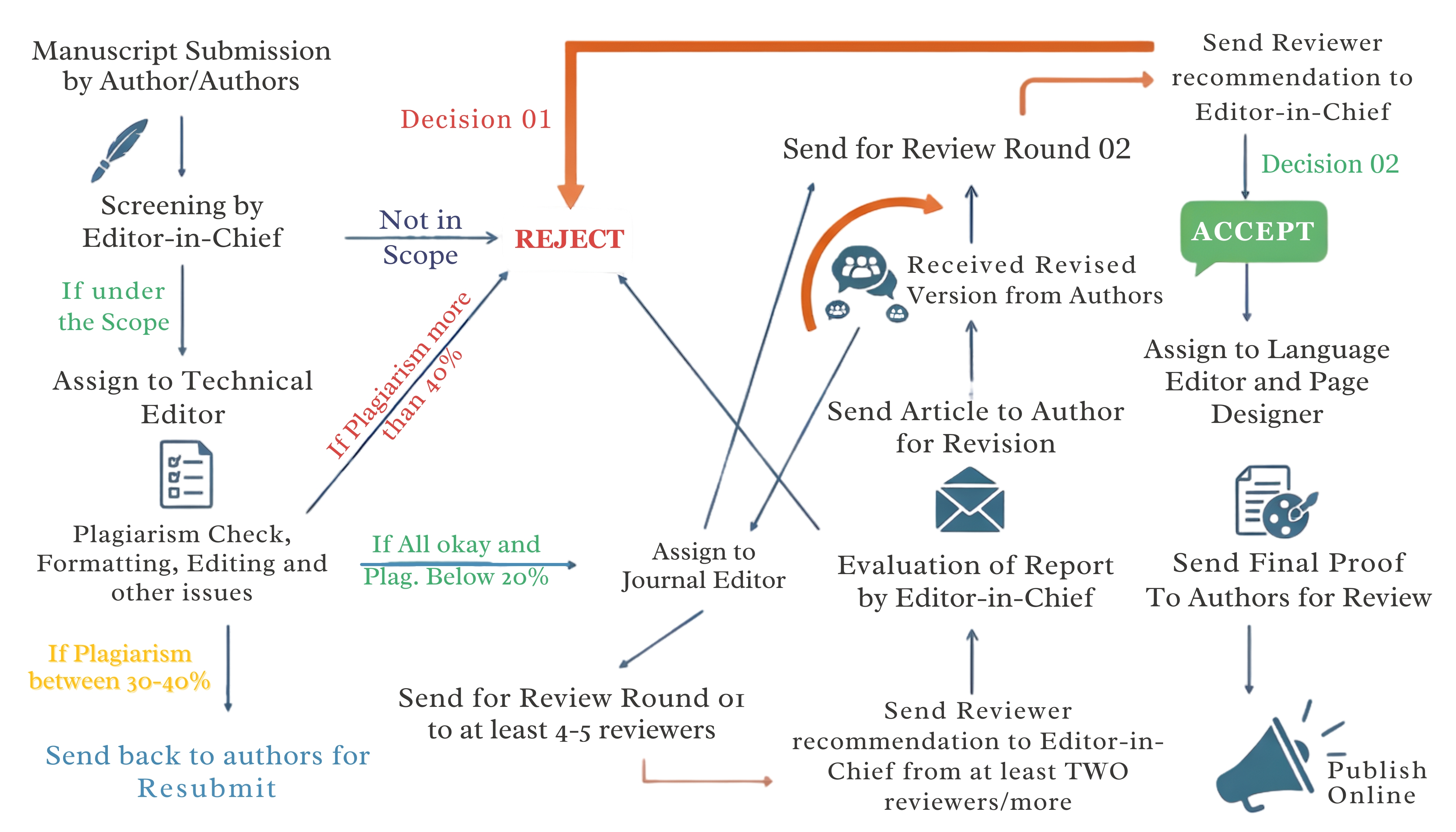
All the manuscripts submitted to the journal will be subjected to a double-blinded peer-review process. In this model, reviewers and the authors both do not know the identities of each other. We believe this process is the best way to ensure the fairest reviews and opinions on papers. The journal follows a rigorous, transparent, and multi-stage peer review process to ensure the quality, originality, and scientific integrity of all published articles. The complete editorial and peer review workflow is outlined below.
1. Manuscript Submission
All manuscripts are submitted online by the author(s) through the journal submission system.
2. Initial Editorial Screening
Upon submission, each manuscript undergoes an initial screening by the Editor-in-Chief to assess:
-
Relevance to the journal’s scope
-
Overall scientific quality
-
Compliance with journal guidelines
Manuscripts that are not within the journal’s scope are rejected at this stage.
3. Technical Evaluation
Manuscripts that pass the initial screening are assigned to a Technical Editor for:
-
Plagiarism check
-
Formatting and structural compliance
-
Language and basic editorial issues
Plagiarism Criteria
-
Plagiarism > 40% → Manuscript is rejected
-
Plagiarism between 30–40% → Manuscript is returned to authors for revision and resubmission
-
Plagiarism ≤ 20% → Manuscript proceeds to peer review
4. Assignment to Handling Editor
Manuscripts meeting technical and ethical requirements are assigned to a Journal/Handling Editor, who oversees the peer review process.
5. Peer Review Process
-
The journal follows a double-blind peer review system.
-
Each manuscript is sent to at least 4–5 independent expert reviewers.
-
Reviewers evaluate the manuscript for originality, methodology, scientific rigor, clarity, and relevance.
6. Reviewer Recommendations
-
Reviewer reports are collected, and recommendations from at least two reviewers are required.
-
Reviewers submit their recommendations to the Editor-in-Chief via the Handling Editor.
7. Editorial Decision
Based on reviewer comments, the Editor-in-Chief may decide to:
-
Reject the manuscript
-
Request revision (minor or major)
-
Proceed to acceptance after revision
8. Revision Process
-
If revisions are required, the manuscript is sent to the authors for revision.
-
Revised manuscripts are re-evaluated by the Editor-in-Chief and, when necessary, sent for additional review rounds.
9. Final Acceptance
Once the Editor-in-Chief is satisfied that all reviewer and editorial comments have been adequately addressed, the manuscript is formally accepted for publication.
10. Post-Acceptance Processing
-
Accepted manuscripts are assigned to a Language Editor and Page Designer.
-
Final proofs are sent to authors for approval.
11. Online Publication
After author approval of the final proof, the article is published online with a DOI and indexed as per journal policy.
Please note, in case the authors challenge the editor's negative decision with suitable arguments, the manuscript can be sent to two more reviewers, and the final decision will be made based upon their recommendations.
Commitment to Ethical Peer Review
The journal is committed to maintaining high ethical standards and follows best practices in peer review, ensuring fairness, confidentiality, transparency, and academic integrity throughout the editorial process.
Average Time for Peer Review: 4-6 weeks