Hydroalcoholic Extraction of Cissus quadrangularis and In Vitro Evaluation of Antifungal Properties
DOI:
https://doi.org/10.66220/vyc7rc95Keywords:
Cissus quadrangularis;, Hydroalcoholic extract;, Phytochemical screening;, Physicochemical analysis;, Antifungal activity;, Fusarium falciforme;Abstract
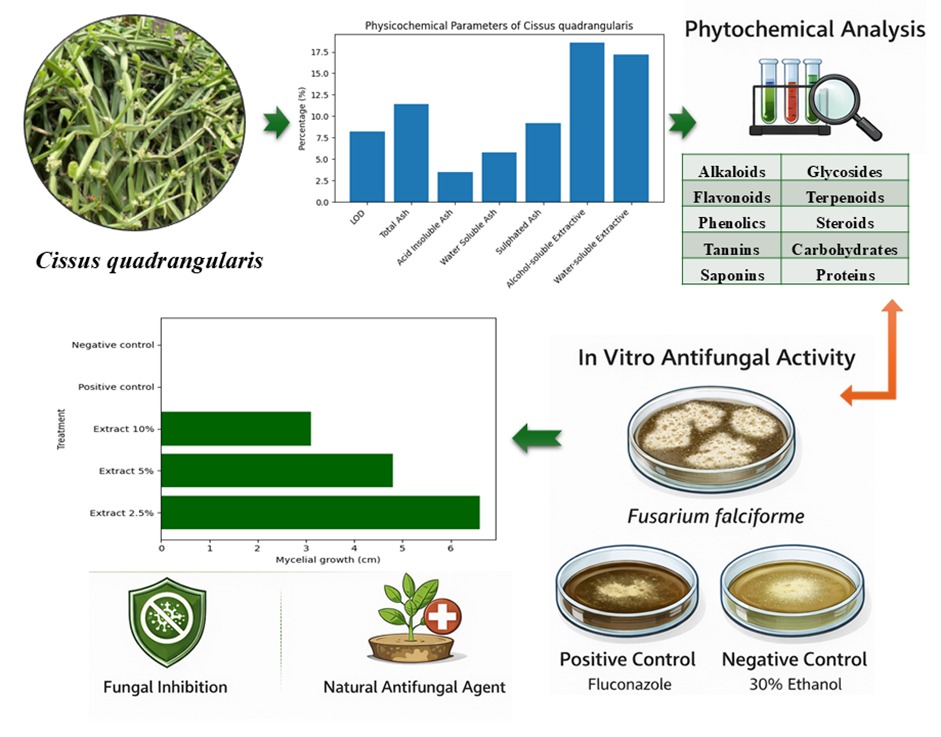
Cissus quadrangularis is a medicinal plant traditionally recognized for its therapeutic potential, yet its antifungal properties remain underexplored. The present study aimed to investigate the physicochemical characteristics, phytochemical composition, and in vitro antifungal activity of the hydroalcoholic extract of Cissus quadrangularis. Plant material was subjected to Soxhlet extraction using a hydroalcoholic solvent system (70% ethanol:30% water). Physicochemical evaluation demonstrated that the extract met acceptable quality standards, with slightly acidic pH, low moisture content, and minimal inorganic and siliceous impurities. The absence of foreign organic matter, heavy metals, and pesticide residues confirmed the purity and safety of the plant material. High alcohol- and water-soluble extractive values indicated efficient extraction of phytoconstituents. Preliminary phytochemical screening revealed flavonoids, phenolic compounds, tannins, saponins, glycosides, terpenoids, steroids, alkaloids, and carbohydrates, while proteins were absent, indicating enrichment of low-molecular-weight bioactive compounds. The antifungal potential of the extract was evaluated against Fusarium falciforme using the food poison method. The results demonstrated a concentration-dependent reduction in radial mycelial growth, with partial inhibition observed in extract-treated plates and the highest inhibition recorded at 10% extract concentration. Radial growth measured 6.6 cm (2.5%), 4.8 cm (5%), and 3.1 cm (10%), corresponding to approximately 17.5%, 40.0%, and 53.1% inhibition, respectively, compared with the control. Complete growth inhibition was observed only in the positive control (fluconazole), whereas the solvent control showed no antifungal effect. Overall, the study highlights the phytochemical richness and notable antifungal potential of Cissus quadrangularis as a promising natural source of antifungal agents.
Downloads
References
1. Ademe M. Immunomodulation for the Treatment of Fungal Infections: Opportunities and Challenges. Front Cell Infect Microbiol. 2020;10:469.
2. Mudenda S. Global Burden of Fungal Infections and Antifungal Resistance from 1961 to 2024: Findings and Future Implications. Pharmacol & Pharm. 2024;15(04):81–112.
3. Marino A, Calvo M, Trovato L, Scalia G, Gussio M, Consoli U, et al. Mucorales/Fusarium Mixed Infection in Hematologic Patient with COVID-19 Complications: An Unfortunate Combination. Pathogens. 2023;12(2):304.
4. Shah DA, Pucci N, Infantino A. Regional and varietal differences in the risk of wheat seed infection by fungal species associated with fusarium head blight in Italy. Eur J Plant Pathol. 2005;112(1):13–21.
5. Bryła M, Pierzgalski A, Zapaśnik A, Uwineza PA, Ksieniewicz-Woźniak E, Modrzewska M, et al. Recent Research on Fusarium Mycotoxins in Maize—A Review. Foods. 2022;11(21);3465.
6. Dar RA, Shahnawaz M, Ahanger MA, Majid I ul. Exploring the Diverse Bioactive Compounds from Medicinal Plants: A Review. J Phytopharm. 2023;12(3):189–95.
7. Bouyahya A, Guaouguaou FE, El Omari N, El Menyiy N, Balahbib A, El-Shazly M, et al. Anti-inflammatory and analgesic properties of Moroccan medicinal plants: Phytochemistry, in vitro and in vivo investigations, mechanism insights, clinical evidences and perspectives. J Pharm Anal. 2022;12(1):35–57.
8. Garg J, Ghoshal G, Bhadada SK, Katare OP. Derivatisation mechanistic-guided identification of phytoconstituents of different extracts of Cissus quadrangularis by TLC and standardization by HPTLC. Phytomedicine Plus. 2024;4(3):100601.
9. Ranganathan S, Ganapathy D, Shanmugam R, Murthykumar K, Sekaran S. Osteogenic Potential of Cissus Quadrangularis: A Systematic Review. Texila Int J Public Heal. 2025;13(1).
10. Farjana HN, Valiathan GM, Mohanasatheesh S. In-silico study on biomolecules derived from Cissus quadrangularis towards anti-inflammation. J Genet Eng Biotechnol. 2025;23(4):100571.
11. Siddiqui FA, Bakshi V. Hydroalcoholic Extraction, Phytoconstituent Profiling by LC-HRMS, and Computational Analysis of Lantana Camara as Potential Glucokinase, Alpha Amylase, Alpha Glucosidase, and DPP-IV Inhibitors. Chem Methodol. 2025;9(12):1189–220.
12. Sruthi V, Shankar Rao GB. Extraction, Phytochemical Screening, and Isolation of Active Fraction of Turnera ulmifolia Linn. Asian J Green Chem. 2024;8(4):411–26.
13. Khan SL, Bakshi V. LC-HRMS and In Silico Analysis of Ailanthus excelsa Metabolites Targeting EGFR Triple Mutation (L858R/T790M/C797S). Adv J Chem Sect A. 2026;9(2):292–311.
14. Chinala KM, Chaithanya A, Sawrov M, Sahithi A, Achyuth C. Phytochemical and Antimicrobial Evaluation of Laurus nobilis Leaves Against Acne and Dandruff-Causing Microorganisms. J Pharm Sci Comput Chem. 2025;1(1):50–7.
15. Priyadarsini SS, Meenaxshi C. Pharmacognostic and phytochemical investigation of the aerial parts of Cissus quadrangularis Linn. J Sci Innov Res. 2013;2(5):872–9.
16. Cho M, Lee J, Jang H, Doo M, Ha JH, Lee HJ. Physicochemical Properties and Sensory Evaluation of Yanggaeng with Alternative Sweeteners and Cissus quadrangularis Powder. Appl Sci. 2026;16(1):44.
17. Ukwubile CA, Mathias SN, Pisagih PS. Acute and Subchronic Toxicity Evaluation and GC-MS Profiling of Ajumbaise: A Traditional Nigerian Polyherbal Formulation for Labor Enhancement and Pain Relief. J Pharm Sci Comput Chem. 2025;1(2):154–73.
18. Jeenu J, Mathews SM. Pharmacognostical Studies on Stems of Clerodendrum infortunatum L. J Drug Deliv Ther. 2025;15(5):17–22.
19. Barus BR, Sitorus P, Masfria. Assessment of physicochemical properties and phytochemical constituents along with antibacterial potential of Tarenna polycarpa leaf fractions. Asian J Pharm Clin Res. 2018;11(4):78–80.
20. Erhonyota C, Edo GI, Onoharigho FO. Comparison of poison plate and agar well diffusion method determining the antifungal activity of protein fractions. Acta Ecol Sin. 2023;43(4):684–9.
21. Lakhdari W, Benyahia I, Bouhenna MM, Bendif H, Khelafi H, Bachir H, et al. Exploration and Evaluation of Secondary Metabolites from Trichoderma harzianum: GC-MS Analysis, Phytochemical Profiling, Antifungal and Antioxidant Activity Assessment. Molecules. 2023;28(13):5025.
22. Khan S, Kale M, Siddiqui F, Nema N. Novel pyrimidine-benzimidazole hybrids with antibacterial and antifungal properties and potential inhibition of SARS-CoV-2 main protease and spike glycoprotein. Digit Chinese Med. 2021;4(2):102–19.
Downloads
Published
Data Availability Statement
Not Applicable
Issue
Section
License
Copyright (c) 2026 Qurratulayen Siddiqui, Yasmeen A. Shaikh (Author)

This work is licensed under a Creative Commons Attribution-NonCommercial 4.0 International License.
In submitting an article to the Journal of PharmTechNova (JPTN) I certify that:
- I am authorized by my co-authors to enter into these arrangements.
- I warrant, on behalf of myself and my co-authors, that:
- the article is original, has not been formally published in any other peer-reviewed journal, is not under consideration by any other journal and does not infringe any existing copyright or any other third party rights;
- I am/we are the sole author(s) of the article and have full authority to enter into this agreement and in granting rights to JPTN are not in breach of any other obligation;
- the article contains nothing that is unlawful, libellous, or which would, if published, constitute a breach of contract or of confidence or of commitment given to secrecy;
- I/we have taken due care to ensure the integrity of the article. To my/our - and currently accepted scientific - knowledge all statements contained in it purporting to be facts are true and any formula or instruction contained in the article will not, if followed accurately, cause any injury, illness or damage to the user.
- I, and all co-authors, agree that the article, if editorially accepted for publication, shall be licensed under the Creative Commons Attribution-NonCommercial 4.0 International License
- I, and all co-authors, agree that, if the article is editorially accepted for publication in the Journal of PharmTechNova (JPTN) data included in the article shall be made available under the Creative Commons 1.0 Public Domain Dedication waiver, unless otherwise stated. For the avoidance of doubt it is stated that sections 1, 2, and 3 of this license agreement shall apply and prevail.