Effect of Sonication on Solubility of Posaconazole in Different Solvents
DOI:
https://doi.org/10.66220/vagg1j45Keywords:
Posaconazole, Sonication, Solubility improvement, Ultrasonic cavitation, PEG 400, Poorly water-soluble drugAbstract
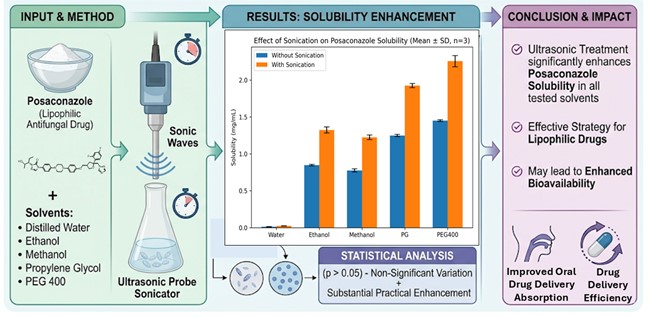
The present study investigated the effect of ultrasonic treatment on the solubility enhancement of posaconazole, a poorly water-soluble BCS Class II antifungal drug, in different pharmaceutical solvents. Saturation solubility studies were performed in distilled water, ethanol, methanol, propylene glycol, and polyethylene glycol 400 (PEG 400) under sonicated and non-sonicated conditions. Sonication significantly improved the solubility of posaconazole in all tested media due to cavitation-induced particle size reduction, enhanced wettability, and improved solute–solvent interaction. The highest percentage enhancement was observed in distilled water, where solubility increased from 0.012 to 0.025 mg/mL (108.3%). Ethanol, methanol, and propylene glycol showed moderate enhancement ranging from 55–56%, while PEG 400 exhibited the highest absolute solubility (2.28 mg/mL) after sonication because of its superior solubilizing capacity. Statistical analysis using one-way ANOVA demonstrated a significant effect of solvent type on drug solubility (p < 0.001), with PEG 400 showing significantly higher solubility than other solvents. The findings demonstrate that sonication is a simple, cost-effective, and scalable approach for improving the solubility and dissolution behaviour of lipophilic drugs. The combination of ultrasonic treatment with suitable solvent systems such as PEG 400 may contribute to enhanced oral bioavailability and offers a practical alternative to complex formulation strategies for poorly water-soluble drugs.
Downloads
References
1. Li J, Nguyen CT, Garcia-Diaz J. Role of new antifungal agents in the treatment of invasive fungal infections in transplant recipients: Isavuconazole and new posaconazole formulations. J Fungi. 2015;1(3):345–66. doi: 10.3390/jof1030345.
2. Nagappan V, Deresinski S. Posaconazole: A broad-spectrum triazole antifungal agent. Clin Infect Dis. 2007;45(12):1610–7. doi: 10.1086/523576.
3. Moore JN, Healy JR, Kraft WK. Pharmacologic and clinical evaluation of posaconazole. Expert Rev Clin Pharmacol. 2015;8(3):321–34. doi: 10.1586/17512433.2015.1034689.
4. Hamza MS, Saleh ZT. Formulation Strategy for Stable Posaconazole Nanoemulsion: Application of Pseudoternary Phase Diagram in Preformulation Design. Int J Appl Pharm. 2025;17(5):426–35. doi: 10.22159/ijap.2025v17i5.55055.
5. Gadewar S, Sangave P, Saoji S, Matte KV, Guntupalli C, Hatware K, et al. Quality by Design (QbD)-Improved Polymeric Micelles of Posaconazole with Increased Solubility, Oral Bioavailability, and Antifungal Activity against Invasive Fungal Infections. J Pharm Innov. 2026;21(2). doi: 10.1007/s12247-025-10335-7.
6. Mandhare PM, Ghuse HA. Formulation-Driven Strategies for Overcoming Solubility Barriers in Drug Development: A Review. Int J Innov Sci Res Technol. 2026;2831. doi: 10.38124/ijisrt/25dec1416.
7. Kozmus G, Zevnik J, Hočevar M, Dular M, Petkovšek M. Characterization of cavitation under ultrasonic horn tip – Proposition of an acoustic cavitation parameter. Ultrason Sonochem. 2022;89. doi: 10.1016/j.ultsonch.2022.106159.
8. Zhang Y, Zhuang L, Ji B, Ren Y, Xu X, He J, et al. Ultrasonic cavitation treatment of o-cresol wastewater and long-term pilot-scale study. J Environ Manage. 2025;375:124208. doi: 10.1016/j.jenvman.2025.124208.
9. Ruiz E, Orozco VH, Hoyos LM, Giraldo LF. Study of sonication parameters on PLA nanoparticles preparation by simple emulsion-evaporation solvent technique. Eur Polym J. 2022;173. doi: 10.1016/j.eurpolymj.2022.111307.
10. Feizi P, Jafari SM. Optimization of astaxanthin extraction from red (Gracilaria corticata) and brown (Sargassum polycystum) macroalgae through ultrasonication and microwave processing. Ultrason Sonochem. 2025;121:107556. doi: 10.1016/j.ultsonch.2025.107556.
11. Sahoo L, Pradhan RK, Mohapatra M, Singh S. Studies on solute–solute and solute–solvent interactions of quercetin and 7-hydroxy flavone with nicotinamide in hydro-ethanolic mixed solvents: bioflavonoid-HBD interactions by volumetric and acoustic analysis. BMC Chem. 2025;19(1):111. doi: 10.1186/s13065-025-01463-9.
12. Martins MJN, Sanches MAR, Polachini TC, de Oliveira EB, Coimbra JSDR, Telis-Romero J. Solubility of different salts used in the control of the water activity of foods. Cienc e Agrotecnologia. 2023;47:e018722. doi: 10.1590/1413-7054202347018722.
13. Jia C, Zhao J, Fang X, Wang P, Xiao A, Zhang H. Preparation of Gypsum–Urea with Enhanced Sustainability from Flue Gas Desulfurization Gypsum in Saturated Urea Solution. Sustain. 2024;16(14):6208. doi: 10.3390/su16146208.
14. Annegowda H V., Bhat R, Min-Tze L, Karim AA, Mansor SM. Influence of sonication treatments and extraction solvents on the phenolics and antioxidants in star fruits. J Food Sci Technol. 2012;49(4):510–4. doi: 10.1007/s13197-011-0435-8.
15. Syazwani N, Azhim A, Morimoto Y, Furukawa KS, Ushida T. Decellularization of aorta tissue using sonication treatment as potential scaffold for vascular tissue engineering. J Med Biol Eng. 2015;35(2):258–69. doi: 10.1007/s40846-015-0028-5.
16. Tahir I, Millevania J, Wijaya K, Mudasir, Wahab RA, Kurniawati W. Optimization of thiamine chitosan nanoemulsion production using sonication treatment. Results Eng. 2023;17. doi: 10.1016/j.rineng.2023.100919.
17. Barzgar S, Tarik M, Ludwig C, Lothenbach B. The effect of equilibration time on Al uptake in C-S-H. Cem Concr Res. 2021;144. doi: 10.1016/j.cemconres.2021.106438.
18. Gogolin C, Eisert J. Equilibration, thermalisation, and the emergence of statistical mechanics in closed quantum systems. Reports Prog Phys. 2016;79(5). doi: 10.1088/0034-4885/79/5/056001.
19. Bormanaki HB, Khoshhal Y. The role of equilibration in piaget’s theory of cognitive development and its implication for receptive skills: A theoretical study. J Lang Teach Res. 2017;8(5):996–1005. doi: 10.17507/jltr.0805.22.
20. Ramadoss K, Meerasa SS, Satyapal AKS, Vijayakumar A, Venugopal V. Quantitative analysis of favipiravir in bulk and pharmaceutical dosage forms using UV visible spectrophotometer. J Med Pharm Allied Sci. 2023;12(2):5680–3. doi: 10.55522/jmpas.V12I2.4410.
21. Garg AK. Quantitative Analysis of Caffeine in the Green Tea, Black Tea and Soft Drink Using UV-Visible Spectrophotometer. Indian J Sci Technol. 2021;14(37):2860–4. doi: 10.17485/IJST/v14i37.2241.
Downloads
Published
Issue
Section
License
Copyright (c) 2026 Mhabub Alam Syed, Sultana Nahida (Author)

This work is licensed under a Creative Commons Attribution-NonCommercial 4.0 International License.
In submitting an article to the Journal of PharmTechNova (JPTN) I certify that:
- I am authorized by my co-authors to enter into these arrangements.
- I warrant, on behalf of myself and my co-authors, that:
- the article is original, has not been formally published in any other peer-reviewed journal, is not under consideration by any other journal and does not infringe any existing copyright or any other third party rights;
- I am/we are the sole author(s) of the article and have full authority to enter into this agreement and in granting rights to JPTN are not in breach of any other obligation;
- the article contains nothing that is unlawful, libellous, or which would, if published, constitute a breach of contract or of confidence or of commitment given to secrecy;
- I/we have taken due care to ensure the integrity of the article. To my/our - and currently accepted scientific - knowledge all statements contained in it purporting to be facts are true and any formula or instruction contained in the article will not, if followed accurately, cause any injury, illness or damage to the user.
- I, and all co-authors, agree that the article, if editorially accepted for publication, shall be licensed under the Creative Commons Attribution-NonCommercial 4.0 International License
- I, and all co-authors, agree that, if the article is editorially accepted for publication in the Journal of PharmTechNova (JPTN) data included in the article shall be made available under the Creative Commons 1.0 Public Domain Dedication waiver, unless otherwise stated. For the avoidance of doubt it is stated that sections 1, 2, and 3 of this license agreement shall apply and prevail.