Development and Optimization of a Feronia elephantum Leaf Extract Ointment: A QbD-Based Approach for Enhanced Anti-Inflammatory Activity
DOI:
https://doi.org/10.66220/gbpwf155Keywords:
Feronia elephantum, Herbal ointment, Topical drug delivery, HRBC membrane stabilization, In vitro anti-inflammatory activity, Quality by Design (QbD)Abstract
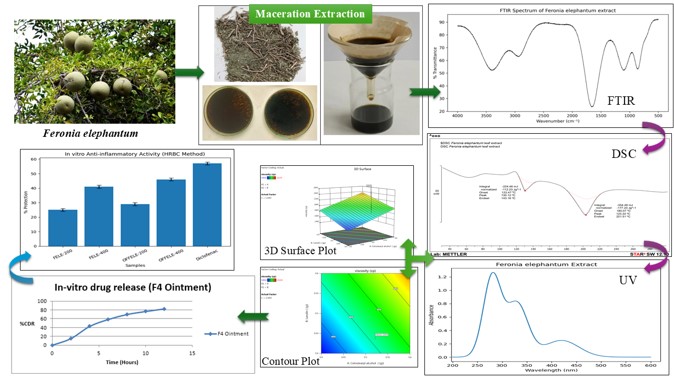
Feronia elephantum possesses significant therapeutic potential owing to its rich phytochemical composition and traditional use in inflammatory disorders. The present study aimed to develop, optimize, and evaluate a topical herbal ointment containing Feronia elephantum leaf extract using a Quality by Design (QbD) approach. The hydroalcoholic extract was prepared by maceration and characterized using FTIR, DSC, and UV spectroscopy. FTIR analysis confirmed the presence of phenolic and flavonoid constituents, while DSC revealed a characteristic endothermic peak at 123.92°C. UV analysis showed a maximum absorption wavelength (λmax) at 275 nm. Extract–excipient compatibility studies demonstrated the absence of significant interactions between the extract and selected excipients. A 2³ full factorial design was employed using cetostearyl alcohol, lanolin, and liquid paraffin as critical material attributes, while viscosity and percentage drug release were selected as critical quality attributes. Eight formulations were prepared and evaluated for physicochemical properties, drug content, spreadability, extrudability, homogeneity, in vitro drug release, and anti-inflammatory activity. The formulations exhibited viscosities ranging from 1450 to 2520 cP and cumulative drug release between 75.2% and 91.8%. Statistical analysis showed that cetostearyl alcohol and lanolin significantly influenced both viscosity and drug release (p < 0.0001). The optimized formulation (F4) demonstrated a viscosity of 2105 cP and drug release of 82.4%. In vitro anti-inflammatory evaluation using the HRBC membrane stabilization method showed that the ointment formulation produced 29.0 ± 1.0% and 46.0 ± 1.0% membrane protection at 200 and 400 mg/mL, respectively, compared with 25.0 ± 1.0% and 41.0 ± 1.0% for the crude extract. Accelerated stability studies indicated minimal changes in pH (6.45–6.61), viscosity (2105–2102 cP), and drug content (95.86–95.30%) over three months. In conclusion, the QbD-optimized Feronia elephantum ointment exhibited satisfactory physicochemical characteristics, controlled drug release, enhanced anti-inflammatory activity, and good stability, indicating its potential as an effective topical herbal formulation for inflammatory conditions.
Downloads
References
1. Drosopoulou K, Kosheleva RI, Ofrydopoulou A, Tsoupras A, Mitropoulos A. Topical and Transdermal Delivery of Nonsteroidal Anti-Inflammatory Drugs (NSAIDs) for Inflammation and Pain: Current Trends and Future Directions in Delivery Systems, Processes 2025, 13(3), 907; doi: 10.3390/pr13030907.
2. Tiwari M. The role of serratiopeptidase in the resolution of inflammation. Asian J Pharm Sci, 2017 May;12(3):209-215. doi: 10.1016/j.ajps.2017.01.003.
3. Al-Khayri JM, Sahana GR, Nagella P, Joseph BV, Alessa FM, Al-Mssallem MQ. Flavonoids as Potential Anti-Inflammatory Molecules: A Review. Molecules 2022, 27(9), 2901; doi: 10.3390/molecules27092901.
4. Dixit K, Chauhan B, Jain R. Anti-Inflammatory Potential of Medicinal Plants in the Management of Inflammatory Diseases: A Review of Mechanisms and Bioactive Compounds. J. Drug Deliv. Ther., 15, 330–40 (2025). doi: 10.22270/jddt.v15i6.7203.
5. Muthulakshmi A, Margret RJ, Mohan VR. Antiulcer effect of Feronia elephantum correa leaf and bark extract in indomethacin induced albino rats. J. Appl. Pharm. Sci., 3, (2013):(4 Suppl 1):S71-S74. doi: 10.7324/JAPS.2013.34.S1.
6. Sharma M, Nagdev S, Bhurat M, Dhankani A, Jain M, Mude G. Feronia elephantum Correa: A Potential Traditional Drug. Int. J. Ayurvedic Med., 12(3), 482–84 (2021). doi: 10.47552/ijam.v12i3.1965.
7. Diarti MW, Harmi KYS, Ahsani DN. Protective effect of ethanolic Feronia elephantum Correa fruit extract on high-fat diet induced steatohepatitis in rats. Universa Med., 40, 36–44 (2021). doi: 10.18051/univmed.2021.v40.36-44.
8. Souto EB, Cano A, Martins-Gomes C, Coutinho TE, Zielińska A, Silva AM. Microemulsions and Nanoemulsions in Skin Drug Delivery. Bioengineering, 9(4), 158, (2022). doi: 10.3390/bioengineering9040158.
9. Mousavi-Simakani SM, Azadi A, Tanideh N, Omidifar N, Ghasemiyeh P, Mohammadi-Samani S. Simvastatin-Loaded Nanostructured Lipid Carriers as Topical Drug Delivery System for Wound Healing Purposes: Preparation, Characterization, and In Vivo Histopathological Studies. Adv. Pharm. Bull., 13(4), 761–71 (2023). doi: 10.34172/apb.2023.083.
10. Al-Jarsha HYM, Ghareeb MM. Validation of UV-visible spectrophotometric method for niclosamide in different media. Trop. J. Pharm. Res., 23(5), 871–80 (2024). doi: 10.4314/tjpr.v23i5.9.
11. Limbachiya P, Patel V, Rami G, Vora J. Chitosan-dibenzylideneacetone based Schiff base: Evaluation of antimicrobial activity and in-vitro cytotoxicity on MCF-7 and L-132. Int. J. Biol. Macromol., 250, (2023). doi: 10.1016/j.ijbiomac.2023.126268.
12. Mohandoss S, Ahmad N, Rizwan Khan M, Rok Lee Y. Physicochemical characterization, solubility enhancement, molecular docking, and antibacterial activity of inclusion complexes of naproxen/β-cyclodextrin derivatives: A comparative study. J. Mol. Liq., 385, (2023). doi: 10.1016/j.molliq.2023.122411.
13. Charoo NA, Shamsher AAA, Zidan AS, Rahman Z. Quality by design approach for formulation development: A case study of dispersible tablets. Int. J. Pharm., 423, 167–78 (2012). doi: 10.1016/j.ijpharm.2011.12.024.
14. Mokhtar HI, Abdel-Salam RA, Hadad GM. Design Space Calculation by In Silico Robustness Simulation with Modeling Error Propagation in QbD Framework of RP-HPLC Method Development. Chromatographia, 78, 457–66 (2015). doi: 10.1007/s10337-015-2858-2.
15. Mahfuz ul Alam A, Mamun IR, Nahar N, Shoeb M. A Quality by Design (QBD) approach for the development and validation of RP-HPLC method for the quantification of linagliptin tablets. Int. J. Pharm. Chem. Anal., 10(4), 281–9 (2023). doi: 10.18231/j.ijpca.2023.047.
16. Alshahrani MS, Alshahrani WK, Assiri SAA, Alasmari WO, Alqahtani AA. Green Chemistry-Based Extraction , Phytochemical Screening , and Evaluation of Anti-Inflammatory Activity of Aerva lanata. J. Phytopharm. Adv. Chem., 01(1), 45–53 (2026). doi: 10.66220/zwjben85.
17. Khan SL, Bakshi V. Physicochemical characterization , GC – MS profiling , and computational evaluation of ailanthus excelsa hydroalcoholic extract against mutant EGFR. Chem. Rev. Lett., 9, 358–76 (2026). doi: 10.22034/crl.2026.571902.1771.
18. Muhammed A, Yakubu J, Maikau FU, Gimba FM, Tanko U, Ibrahim S. Phytochemical Screening , Isolation , Characterization and Antimicrobial Evaluation of Syzygium cumini Leaf Extracts. J. Chem. Technol., 2, 17–25 (2026). doi: 10.22034/jchemtech.2025.542808.1019.
19. DA B. Exploring Diverse Techniques for Phytochemical Extraction from Plant Sources A Comprehensive Review. Int. J. Pharmacogn. Chinese Med., 8(1), 1–11 (2024). doi: 10.23880/ipcm-16000266.
20. Altemimi A, Lakhssassi N, Baharlouei A, Watson DG, Lightfoot DA. Phytochemicals: Extraction, isolation, and identification of bioactive compounds from plant extracts. Plants (Basel). 2017 Sep 22;6(4):42. doi: 10.3390/plants6040042.
21. Boyaci IH, Genis HE, Guven B, Tamer U, Alper N. A novel method for quantification of ethanol and methanol in distilled alcoholic beverages using Raman spectroscopy. J. Raman Spectrosc., 43, 1171–6 (2012). doi: 10.1002/jrs.3159.
22. Caruso R, Gambino GL, Scordino M, Sabatino L, Traulo P, Gagliano G. Gas chromatographic quantitative analysis of methanol in wine: Operative conditions, optimization and calibration model choice. Nat. Prod. Commun., 6, 1939–43 (2011). doi: 10.1177/1934578x1100601237.
23. Patel P, Ahir K, Patel V, Manani L, Patel C. Drug-Excipient compatibility studies : First step for dosage form development. Pharma Innov. J., 4(5), 14–20 (2015).
24. Pramod K, Suneesh CV, Shanavas S, Ansari SH, Ali J. Unveiling the compatibility of eugenol with formulation excipients by systematic drug-excipient compatibility studies. J. Anal. Sci. Technol., 6, 34(2015). doi: 10.1186/s40543-015-0073-2.
25. Fisher F, Africa C, Klaasen J, Fisher R. South African Medicinal Plants Traditionally Used for Wound Treatment: An Ethnobotanical Systematic Review. Plants (Basel), 2025, 14(5):818. doi: 10.3390/plants14050818.
26. Andrade C. Understanding Factorial Designs, Main Effects, and Interaction Effects: Simply Explained with a Worked Example. Indian J. Psychol. Med., 46, 175–7 (2024). doi: 10.1177/02537176241237066.
27. Jankovic A, Chaudhary G, Goia F. Designing the design of experiments (DOE) – An investigation on the influence of different factorial designs on the characterization of complex systems. Energy Build., 250, (2021). doi: 10.1016/j.enbuild.2021.111298.
28. Ajith K, Pillai AS, Muthu Vijayan Enoch IV, Sharifpur M, Solomon AB, Meyer JP. Effect of the non-electrically conductive spindle on the viscosity measurements of nanofluids subjected to the magnetic field. Colloids Surfaces A Physicochem. Eng. Asp., 628, (2021). doi: 10.1016/j.colsurfa.2021.127252.
29. Vishvnath G, Jain UK. Quantitative analysis of piperine in ayurvedic formulation by UV Spectrophotometry. Int. J., 2(2), 58–61 (2011).
30. Bao Q, Shen J, Jog R, Zhang C, Newman B, Wang Y, Choi S, Burgess DJ. In vitro release testing method development for ophthalmic ointments. Int. J. Pharm., 526, 145–56 (2017). doi: 10.1016/j.ijpharm.2017.04.075.
31. Askarizadeh M, Esfandiari N, Honarvar B, Sajadian SA, Azdarpour A. Kinetic Modeling to Explain the Release of Medicine from Drug Delivery Systems. ChemBioEng Rev., 10, 1006–49 (2023). doi: 10.1002/cben.202300027.
32. González-González O, Ramirez IO, Ramirez BI, O’Connell P, Ballesteros MP, Torrado JJ, Serrano DR. Drug Stability: ICH versus Accelerated Predictive Stability Studies. Pharmaceutics, 14(11):2324, (2022). doi: 10.3390/pharmaceutics14112324.
33. Truong DH, Nguyen DH, Ta NTA, Bui AV, Do TH, Nguyen HC. Evaluation of the use of different solvents for phytochemical constituents, antioxidants, and in vitro anti-inflammatory activities of severinia buxifolia. J. Food Qual., 2019:8178294. doi: 10.1155/2019/8178294.
Downloads
Published
Issue
Section
License
Copyright (c) 2026 Inzamamul Haq Ameer Shaikh, Sharad D. Tayade, Arfin S. Tamboli, Kedar Kailas Ganjare, Vijay S. Borkar, Jyoti Bhushan Khedekar (Author)

This work is licensed under a Creative Commons Attribution-NonCommercial 4.0 International License.
In submitting an article to the Journal of PharmTechNova (JPTN) I certify that:
- I am authorized by my co-authors to enter into these arrangements.
- I warrant, on behalf of myself and my co-authors, that:
- the article is original, has not been formally published in any other peer-reviewed journal, is not under consideration by any other journal and does not infringe any existing copyright or any other third party rights;
- I am/we are the sole author(s) of the article and have full authority to enter into this agreement and in granting rights to JPTN are not in breach of any other obligation;
- the article contains nothing that is unlawful, libellous, or which would, if published, constitute a breach of contract or of confidence or of commitment given to secrecy;
- I/we have taken due care to ensure the integrity of the article. To my/our - and currently accepted scientific - knowledge all statements contained in it purporting to be facts are true and any formula or instruction contained in the article will not, if followed accurately, cause any injury, illness or damage to the user.
- I, and all co-authors, agree that the article, if editorially accepted for publication, shall be licensed under the Creative Commons Attribution-NonCommercial 4.0 International License
- I, and all co-authors, agree that, if the article is editorially accepted for publication in the Journal of PharmTechNova (JPTN) data included in the article shall be made available under the Creative Commons 1.0 Public Domain Dedication waiver, unless otherwise stated. For the avoidance of doubt it is stated that sections 1, 2, and 3 of this license agreement shall apply and prevail.