Health Implications of 5G Radiofrequency Exposure on Respiratory Diseases: A Comprehensive Review
DOI:
https://doi.org/10.66220/bzm92j49Keywords:
Inflammatory signaling, Oxidative stress, Public health, Radiofrequency electromagnetic fields (RF-EMF), Reactive oxygen species (ROS), respiratory diseases; 5G wireless technologyAbstract
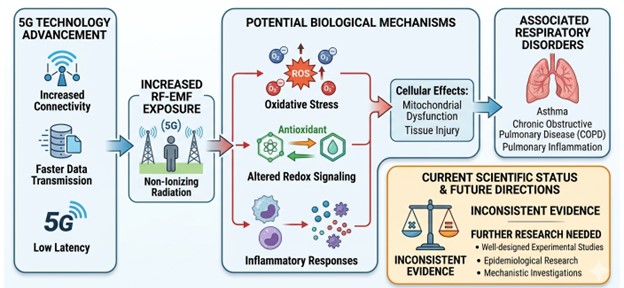
The rapid advancement of fifth-generation (5G) wireless communication technology has significantly enhanced global connectivity, enabling faster data transmission, low latency communication, and the expansion of digital infrastructure. Despite these technological benefits, increasing concerns have been raised regarding the potential health effects associated with prolonged exposure to radiofrequency electromagnetic fields (RF-EMFs) generated by wireless communication systems. This review aims to summarize current scientific evidence on the possible health implications of 5G radiofrequency exposure on respiratory diseases and to discuss the biological mechanisms that may be involved. Radiofrequency radiation used in wireless communication belongs to the non-ionizing region of the electromagnetic spectrum and does not possess sufficient energy to directly damage DNA or ionize biological molecules. However, several experimental studies have suggested that RF-EMF exposure may influence important cellular processes, including oxidative stress, redox signaling, and inflammatory responses. Increased production of reactive oxygen species (ROS) and alterations in antioxidant defense mechanisms have been observed in both in vitro and in vivo studies, indicating potential oxidative damage at the cellular level. These biological changes may contribute to mitochondrial dysfunction, tissue injury, and activation of inflammatory pathways associated with respiratory disorders such as asthma, chronic obstructive pulmonary disease (COPD), and pulmonary inflammation. Nevertheless, the overall scientific evidence remains inconsistent due to variations in exposure conditions, experimental models, and study methodologies. Therefore, further well-designed experimental, epidemiological, and mechanistic studies are necessary to better understand the relationship between RF-EMF exposure and respiratory health outcomes.
Downloads
References
1. Tran-Dang H, Kim DS. Digital Twin-empowered intelligent computation offloading for edge computing in the era of 5G and beyond: A state-of-the-art survey. ICT Express. 2025;11(1):167–80. doi: 10.1016/j.icte.2025.01.002.
2. He D, Yuan W, Wu J, Liu R. Ubiquitous UAV Communication Enabled Low-Altitude Economy: Applications, Techniques, and 3GPP’s Efforts. IEEE Netw. 2025; 40(01):115-122. doi: 10.1109/MNET.2025.3574922.
3. Mohit, Selvakumar P, Manjunath TC, Mehra J, Madaan S, Balu N. The ubiquitous internet and smart computation available 24/7 for anyone and anywhere. Educ AI Humanoid Comput Devices Cyber Nomads. 2025;247–70. doi: 10.4018/979-8-3693-8985-0.ch010.
4. Kumar S, Dixit AS, Malekar RR, Raut HD, Shevada LK. Fifth generation antennas: A comprehensive review of design and performance enhancement techniques. IEEE Access. 2020;8:163568–93. doi: 10.1109/ACCESS.2020.3020952.
5. Lu HH, Huang SF. Assessing the key factors influencing 4G users’ intentions to upgrade to 5G networks. Technol Soc. 2025;81:102810. doi: j.techsoc.2024.102810.
6. Devi MK, Priya MP. Evolution of next generation networks and its contribution towards Industry 5.0. In: Resource Management in Advanced Wireless Mobile Networks. 2023. p. 45–80. doi: 10.1002/9781119827603.ch3
7. Kiouvrekis Y, Panagiotakopoulos T. Electromagnetic Field Distribution Mapping: A Taxonomy and Comprehensive Review of Computational and Machine Learning Methods. Computers. 2025;14(9):373. doi: 10.3390/computers14090373.
8. Ajibare AT, Vipin B, Babalola OP. Enhancing QoS and RF-EMF Radiation Using RSMA and AI in 6G Networks: A Comprehensive Survey. IEEE Access. 2025;13:190539–55. doi: 10.1109/ACCESS.2025.3628914.
9. Salem MA, Lim HS, Diong KS, Alaghbari KA, Zarakovitis CC, Chien SF. Electromagnetic Field-Aware Radio Resource Management for 5G and Beyond: A Survey. Computers. 2025;14(2):51. doi: 10.3390/computers14020051.
10. Oladipo AA, Adisa VI, Ogunkola BD, Oladapo OM, Ajeigbe SB, Adedoyin OO, et al. Impact of electromagnetic radiation on human reproduction health: Causes, consequences, and potential therapeutic approaches. J Radiat Res Appl Sci. 2025;18(4):102010. doi: j.jrras.2025.102010.
11. Bektas H, Dasdag S. The effects of radiofrequency radiation on male reproductive health and potential mechanisms. Vol. 44, Electromagnetic Biology and Medicine. 2025. 44(3):359-384. doi: 10.1080/15368378.2025.2480664.
12. Hashmi MUA, Ilyas N. Effects of Ionizing and Non-Ionizing Radiation on Animal Physiology and Behaviour: An Interdisciplinary Review. Kashmir J Sci. 2025;4(4):24–34.
13. Balasubramanian D, Agraharam G, Girigoswami A, Girigoswami K. Multiple radiations and its effect on biological system–a review on in vitro and in vivo mechanisms. Ann Med. 2025;57(1). doi: 10.63147/krjs.v4i4.225.
14. Urrutia-Pereira M, Solé D. Impact of climate change and air pollution on childhood respiratory health. J Pediatr (Rio J). 2025;101:S65–69. doi: 10.1016/j.jped.2024.11.007.
15. Zhang YC, Zhang L, Zhou PT, Xie ZH, Zhang WJ, Fan M, et al. Environmental exposure to air pollution and climate: Intersecting the impact on ear and nose health and chemosensory function (Review). Int J Mol Med. 2026;57(3):55. doi: 10.3892/ijmm.2025.5726.
16. O’Brien C, Sommerfield D, Sommerfield A, Hauser N, von Ungern-Sternberg BS. Environmental exposure to air pollution and pollen and the risk of perioperative respiratory adverse events in paediatric anaesthesia: A narrative review. Anaesth Crit Care Pain Med. 2025;44(6):101601. doi: 10.1016/j.accpm.2025.101601.
17. Halpin DM, Masekela R, Vogelmeier CF, Ozoh OB, Cruz AA, Reddel HK, et al. Addressing the global challenges of COPD and asthma: a shared vision from the global initiative for chronic obstructive pulmonary disease (GOLD) and the global initiative for asthma (GINA). Eur Respir J. 2025; 5;67(2):2502244. doi: 10.1183/13993003.02244-2025.
18. Samarova US, Kalbagaeva ZY, Zgotova NS, Yegizbayeva GS, Nogayeva MG, Tazhibayeva KN, et al. Prevalence of Chronic Obstructive Pulmonary Disease As a Global Health Problem. Наука И Здравоохранение. 2025;(3(27)):200–14. doi: 10.34689/SH.2024.27.3.022.
19. Xu A, Liu Y, Li S, Zhan C, Cheng Y, Zhang C, et al. Global burden of major chronic respiratory diseases among older adults aged 55 and above from 1990 to 2021: Changes, challenges, and predictions amid the pandemic. PLoS One. 2025; 20(8):e0329283. doi: 10.1371/journal.pone.0329283.
20. Frank JW. Epidemiological criteria for causation applied to human health harms from RF-EMF exposure: Bradford Hill revisited. Front Public Heal. 2025; 27:13:1559868. doi: 10.3389/fpubh.2025.1559868.
21. Weller SG, McCredden JE, Leach V, Chu C, Lam AK yin. A scoping review and evidence map of radiofrequency field exposure and genotoxicity: assessing in vivo, in vitro, and epidemiological data. Front Public Heal. 2025; 13:1613353. doi: 10.3389/fpubh.2025.1613353.
22. Panagopoulos DJ, Yakymenko I, De Iuliis GN, Chrousos GP. A comprehensive mechanism of biological and health effects of anthropogenic extremely low frequency and wireless communication electromagnetic fields. Front Public Heal. 2025; 13:1585441. doi: 10.3389/fpubh.2025.1585441.
23. Shntaif AH, Khan S, Tapadiya G, Chettupalli A, Saboo S, Shaikh MS, et al. Rational drug design, synthesis, and biological evaluation of novel N-(2-arylaminophenyl)-2,3-diphenylquinoxaline-6-sulfonamides as potential antimalarial, antifungal, and antibacterial agents. Digit Chinese Med. 2021;4(4):290–304. doi: 10.1016/j.dcmed.2021.12.004.
24. Namdeo PK, Mishra S, Das A, Tiwari RR, Subbiah R. The interplay between microRNAs and oxidative stress and its implications in respiratory diseases. Vol. 59, Free Radical Research. 2025. p. 667–87. doi: 10.1080/10715762.2025.2564674.
25. Qu C, Bai C, Luo J, Xie D, Pan H, Xuan L, et al. Environmental low-dose nanosized carbon black exposure aggravates lung fibrosis-induced by radiation in vivo and in vitro. Sci Total Environ. 2025;972. doi: 10.1016/j.scitotenv.2025.179119.
26. Poljak D, Doric V, Galic M, Sesnic ZN. On the Use of Efficient Methods for the Assessment of Radiated Field from Radio Base Station Antennas and Related Legal Issues Pertaining to Human Exposure to Nonionizing Radiation. 2025 MIPRO 48th ICT Electron Conv MIPRO 2025 - Proc. 2025;879–84. doi: 10.1109/MIPRO65660.2025.11131761.
27. Villaescusa-Tebar A, Garcia-Pardo C. Assessment of 5G RF-EMF Exposure During Large-Scale Public Events via Field Measurements. IEEE Access. 2025;13:150489–97. doi: 10.1109/ACCESS.2025.3602263.
28. Rathebe PC, Kholopo M. Low-Cost Sensors in 5G RF-EMF Exposure Monitoring: Validity and Challenges. Sensors. 2026;26(2):533. doi: 10.3390/s26020533.
29. Hardell L, Nilsson M. Summary of seven Swedish case reports on the microwave syndrome associated with 5G radiofrequency radiation. Vol. 40, Reviews on Environmental Health. 2025;19;40(1):147-157. doi: 10.1515/reveh-2024-0017.
30. Vaupotič N, Grellier J, Martin L, Domènech Panicello C, Goszczyńska E, Kojimahara N, et al. 5G technology, health and society: misconceptions, blind spots and insights from experts, non-experts, and self-identified electrosensitive individuals. J Risk Res. 2025;28(5):446–70. doi: 10.1080/13669877.2025.2512074.
31. do Nascimento Martinez L, da Silva MAP, Fialho SN, Almeida ML, Dos Santos Ferreira A, de Jesus Gouveia A, et al. Antiplasmodial activity of coumarins isolated from Polygala boliviensis: in vitro and in silico studies. J Biomol Struct Dyn. 2025;14(1):1-21. doi: 10.1080/07391102.2023.2173295.
32. Meyer F, Bitsch A, Forman HJ, Fragoulis A, Ghezzi P, Henschenmacher B, et al. The effects of radiofrequency electromagnetic field exposure on biomarkers of oxidative stress in vivo and in vitro: A systematic review of experimental studies. Environ Int. 2024;194:108940. doi: 10.1016/j.envint.2024.108940.
33. Martelli LSR, Machado I V., dos Santos JRN, Corrêa AG. Recent Advances in Greener Asymmetric Organocatalysis Using Bio-Based Solvents. Vol. 13, Catalysts. 2023; 13(3):553. doi: 10.3390/catal13030553.
34. Schuermann D, Mevissen M. Manmade electromagnetic fields and oxidative stress— biological effects and consequences for health. Vol. 22, International Journal of Molecular Sciences. 2021: 22(7):3772. doi: 10.3390/ijms22073772.
35. Kivrak E, Yurt K, Kaplan A, Alkan I, Altun G. Effects of electromagnetic fields exposure on the antioxidant defense system. J Microsc Ultrastruct. 2017;5(4):167. doi: 10.1016/j.jmau.2017.07.003.
36. Yakymenko I, Tsybulin O, Sidorik E, Henshel D, Kyrylenko O, Kyrylenko S. Oxidative mechanisms of biological activity of low-intensity radiofrequency radiation. Electromagn Biol Med. 2016;35(2):186–202. doi: 10.3109/15368378.2015.1043557.
37. Jangid P, Rai U, Ahmed S, Singh S, Singh R. Non-thermal biological effects of radiofrequency electromagnetic radiation: Mechanistic insights into male reproductive vulnerability in the era of ubiquitous exposure. Vol. 138, Reproductive Toxicology. 2025; 138:109087. doi: j.reprotox.2025.109087.
38. Sadeqi MR, Azizi NM. Health Effects of Electromagnetic Radiation: A Focus on Radiofrequency (RF) and Microwave Radiation. J Nat Sci Rev. 2025;3(4):276–92. doi: 10.62810/jnsr.v3i4.274.
39. Salameh M, Zeitoun-Ghandour S, Sabra L, Ismail L, Daher A, Bazzi A, et al. Effects of continuous prenatal and postnatal global system for mobile communications electromagnetic waves (GSM-EMW) exposure on the oxidative stress biomarkers in female rat liver. Heliyon. 2022;8(12):e12367. doi: 10.1016/j.heliyon.2022.e12367.
40. Pall ML. Wi-Fi is an important threat to human health. Environ Res. 2018;164:405–16. doi: j.envres.2018.01.035.
41. R Beverly, RR Brown. Evidence for a connection between COVID-19 and exposure to radiofrequency radiation from wireless communications including 5G. J Clin Transl Res. 2021;29:7(5):666-81. doi: 10.18053/jctres.07.202105.007.
42. Esmekaya MA, Aytekin E, Ozgur E, Güler G, Ergun MA, Ömeroǧlu S, et al. Mutagenic and morphologic impacts of 1.8GHz radiofrequency radiation on human peripheral blood lymphocytes (hPBLs) and possible protective role of pre-treatment with Ginkgo biloba (EGb 761). Sci Total Environ. 2011;410–411:59–64. doi: 10.1016/j.scitotenv.2011.09.036.
43. Yurekli A, Ozkan M, Kalkan T, Saybasili H, Tuncel H, Atukeren P, et al. GSM base station electromagnetic radiation and oxidative stress in rats. Electromagn Biol Med. 2006;25(3):177–88. doi: 10.1080/15368370600875042.
44. Dasdag S, Bilgin HM, Akdag MZ, Celik H, Aksen F. Effect of long term mobile phone exposure on oxidative-antioxidative processes and nitric oxide in rats. Biotechnol Biotechnol Equip. 2008;22(4):992–7. doi: 10.1080/13102818.2008.10817595.
45. López-Martín E, Sueiro-Benavides R, Leiro-Vidal JM, Rodríguez-González JA, Ares-Pena FJ. Redox cell signalling triggered by black carbon and/or radiofrequency electromagnetic fields: Influence on cell death. Sci Total Environ. 2024;953:176023. doi: 10.1016/j.scitotenv.2024.176023.
46. De Almeida AJPO, De Oliveira JCPL, Da Silva Pontes LV, De Souza Júnior JF, Gonçalves TAF, Dantas SH, et al. ROS: Basic Concepts, Sources, Cellular Signaling, and its Implications in Aging Pathways. Oxid Med Cell Longev. 2022;19:2022:1225578. doi: 10.1155/2022/1225578.
47. Cotta RMM, de Souza Ferreira E, de Aguiar Franco F, da Costa Souza Barros G, Januário JPT, Moreira TR, et al. The effectiveness of faculty development programs for training university professors in the health area: a systematic review and meta-analysis. BMC Med Educ. 2024;24(1):768. doi: 10.1186/s12909-024-05735-1.
48. Hardell L, Carlberg M. Health risks from radiofrequency radiation, including 5G, should be assessed by experts with no conflicts of interest. Oncol Lett. 2020;20(4):15. doi: 10.3892/ol.2020.11876.
49. Kappler K, Wandrey F, Branka JE, Poigny S, Zülli F. Development of an in Vitro Assay to Evaluate the Biological Impact of 5G Technology on Human Skin—Shield Effect of a Tannin-Rich Plant Extract. J Cosmet Dermatological Sci Appl. 2022;12(02):100–8. doi: 10.4236/jcdsa.2022.122009.
50. Simkó M, Mattsson MO. 5G wireless communication and health effects—A pragmatic review based on available studies regarding 6 to 100 GHz. Int J Environ Res Public Health. 2019;16(18):3406. doi: 10.3390/ijerph16183406.
51. Lin Z, Du X, Chen HH, Ai B, Chen Z, Wu D. Millimeter-wave propagation modeling and measurements for 5g mobile networks. IEEE Wirel Commun. 2019;26(1):72–77. doi: 10.1109/MWC.2019.1800035.
52. World Health Organization. World Health Organization . 2020. 5G mobile networks and health. Manila: World Health Organization.
53. Hardell L, Nyberg R. Appeals that matter or not on a moratorium on the deployment of the fifth generation, 5G, for microwave radiation. Mol Clin Oncol. 2020;12(3):247–57. doi: 10.3892/mco.2020.1984.
54. Russell CL. 5 G wireless telecommunications expansion: Public health and environmental implications. Environ Res. 2018;165:484–95. doi: 10.1016/j.envres.2018.01.016.
55. Kim SJ, Jang YW, Hyung KE, Lee DK, Hyun KH, Jeong SH, et al. Extremely low-frequency electromagnetic field exposure enhances inflammatory response and inhibits effect of antioxidant in RAW 264. 7 cells. Bioelectromagnetics. 2017;38(5):374–85. doi: 10.1002/bem.22049.
56. Jiménez-López R, Martín-Chaves L, Gutiérrez-García ÁM, Carmona-Segovia A del M, Mora-Ordoñez B, Sánchez-García AM, et al. Distinct cytokine profiles in plasma and tears highlight ophthalmologic inflammation in type 2 diabetes without retinopathy. Front Med. 2025;12. doi: 10.3389/fmed.2025.1631334.
57. Kim HJ, Kim D, Lee M, Jang A. Anti-inflammatory effect of dietary pork extract on proliferation and cytokine secretion using mouse primary splenocytes. Food Res Int. 2017;102:710–6. doi: 10.1016/j.foodres.2017.09.058.
58. Merighi S, Gessi S, Bencivenni S, Battistello E, Vincenzi F, Setti S, et al. Signaling pathways involved in anti-inflammatory effects of Pulsed Electromagnetic Field in microglial cells. Cytokine. 2020;125:154777. doi: 10.1016/j.cyto.2019.154777.
59. Melnick RL, Moskowitz JM, Héroux P, Mallery-Blythe E, McCredden JE, Herbert M, et al. The WHO-commissioned systematic reviews on health effects of radiofrequency radiation provide no assurance of safety. Vol. 24, Environmental Health: A Global Access Science Source. 2025; 2;24(1):70. doi: 10.1186/s12940-025-01220-4.
Downloads
Published
Data Availability Statement
“All relevant data supporting the findings of this study are included within the manuscript.”
Issue
Section
License
Copyright (c) 2026 Phanindra Erukulla, Pericharla Venkata Narasimha Raju (Author)

This work is licensed under a Creative Commons Attribution-NonCommercial 4.0 International License.
In submitting an article to the Journal of PharmTechNova (JPTN) I certify that:
- I am authorized by my co-authors to enter into these arrangements.
- I warrant, on behalf of myself and my co-authors, that:
- the article is original, has not been formally published in any other peer-reviewed journal, is not under consideration by any other journal and does not infringe any existing copyright or any other third party rights;
- I am/we are the sole author(s) of the article and have full authority to enter into this agreement and in granting rights to JPTN are not in breach of any other obligation;
- the article contains nothing that is unlawful, libellous, or which would, if published, constitute a breach of contract or of confidence or of commitment given to secrecy;
- I/we have taken due care to ensure the integrity of the article. To my/our - and currently accepted scientific - knowledge all statements contained in it purporting to be facts are true and any formula or instruction contained in the article will not, if followed accurately, cause any injury, illness or damage to the user.
- I, and all co-authors, agree that the article, if editorially accepted for publication, shall be licensed under the Creative Commons Attribution-NonCommercial 4.0 International License
- I, and all co-authors, agree that, if the article is editorially accepted for publication in the Journal of PharmTechNova (JPTN) data included in the article shall be made available under the Creative Commons 1.0 Public Domain Dedication waiver, unless otherwise stated. For the avoidance of doubt it is stated that sections 1, 2, and 3 of this license agreement shall apply and prevail.