Development, Optimization and Evaluation of Naproxen Amorphous ASDs Tablets for Enhanced Solubility and Dissolution Using Hydrophilic Polymers
DOI:
https://doi.org/10.66220/75p78209Keywords:
Amorphous solid dispersion, Dissolution study, Factorial design, Naproxen, Response surface methodology, Solubility enhancement, Solvent evaporation, Tablet formulationAbstract
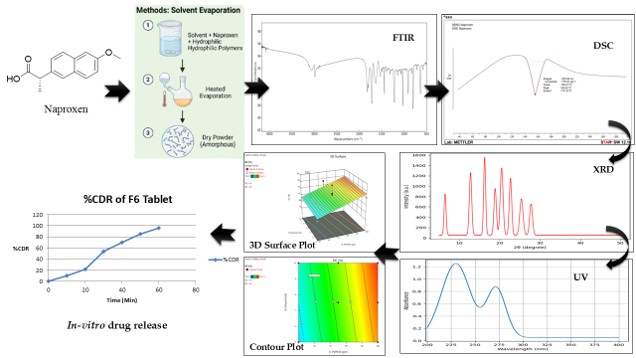
Naproxen is a widely prescribed non-steroidal anti-inflammatory drug (NSAID) belonging to Biopharmaceutical Classification System (BCS) Class II, exhibiting high permeability but poor aqueous solubility, which limits its dissolution rate and oral bioavailability. The present study aimed to develop, optimize, and evaluate amorphous solid dispersions (ASDs) of naproxen using hydrophilic polymers to improve its solubility and dissolution characteristics. Preformulation studies including melting point determination, Fourier Transform Infrared Spectroscopy (FTIR) spectroscopy, differential scanning calorimetry (DSC), powder X-ray diffraction (PXRD), UV spectrophotometric analysis, and solubility studies confirmed the identity, purity, and crystalline nature of naproxen. ASDs were prepared by the solvent evaporation method using PVP K30, PEG 6000, HPMC E5, and Poloxamer 188 individually and in combinations. Preliminary screening demonstrated that PVP K30 exhibited the highest solubility enhancement, while the combination of PVP K30 and PEG 6000 showed synergistic improvement. Formulation variables were optimized using response surface methodology (RSM) based on a factorial design with polymer concentration and ethanol volume as independent variables. The optimized formulation (F6) exhibited a production yield of 95.40%, drug content of 86.23%, and 95.68% cumulative drug release within 60 minutes. FTIR and DSC analyses confirmed the absence of significant drug–polymer interactions and indicated successful formation of the ASDs. The optimized dispersion was compressed into tablets that demonstrated acceptable pre- and post-compression characteristics, including hardness, friability, weight variation, and drug content. The tablet formulation released 96.23% of drug within 60 minutes and followed the Korsmeyer–Peppas kinetic model, suggesting anomalous drug release behavior. Accelerated stability studies conducted for three months revealed no significant changes in physicochemical properties or dissolution profile. The findings demonstrate that the developed ASDs tablet effectively enhances the solubility and dissolution of naproxen and represents a promising strategy for improving its oral bioavailability.
Downloads
References
Aguiar ASN, Felimberti PZ, Duarte VS, Borges LL, Camargo AJ, Perjesi P, et al. Structural Studies of Sodium Counterion on Naproxen: From Solid State to Stability. Adv Phys Res. 2025;4(12). doi: 10.1002/apxr.202500159.
2. Kim H, Jang S, Kim IW. Enhanced dissolution of naproxen by combining cocrystallization and eutectic formation. Pharmaceutics. 2021;13(5). doi: 10.3390/pharmaceutics13050618.
3. Priyadarshinee S, Umamaheswari S, Ramesh M. Non-steroidal Anti-inflammatory Drug (NSAID) Naproxen-Induced Hepatotoxicity in a Freshwater Fish Labeo rohita. Water Air Soil Pollut. 2023;234(1). doi: 10.1007/s11270-022-06045-2.
4. Bárdos V, Szolláth R, Tőzsér P, Mirzahosseini A, Sinkó B, Angi R, et al. Study of the Influence of Pharmaceutical Excipients on the Solubility and Permeability of BCS Class II Drugs. Sci Pharm. 2025;93(2). doi: 10.3390/scipharm93020019.
5. Sievens-Figueroa L, Bhakay A, Jerez-Rozo JI, Pandya N, Romañach RJ, Michniak-Kohn B, et al. Preparation and characterization of hydroxypropyl methyl cellulose films containing stable BCS Class II drug nanoparticles for pharmaceutical applications. Int J Pharm. 2012;423(2):496–508. doi: 10.1016/j.ijpharm.2011.12.001.
6. Latif MS, Al-Harbi FF, Nawaz A, Rashid SA, Farid A, Mohaini M Al, et al. Formulation and Evaluation of Hydrophilic Polymer Based Methotrexate Patches: In Vitro and In Vivo Characterization. Polymers (Basel). 2022 Mar;14(7):1310. doi: 10.3390/polym14071310.
7. Hirun N, Kraisit P, Tantishaiyakul V. Thermosensitive Polymer Blend Composed of Poloxamer 407, Poloxamer 188 and Polycarbophil for the Use as Mucoadhesive In Situ Gel. Polymers (Basel). 2022;14(9). doi: 10.3390/polym14091836.
8. Veza I, Spraggon M, Fattah IMR, Idris M. Response surface methodology (RSM) for optimizing engine performance and emissions fueled with biofuel: Review of RSM for sustainability energy transition. Vol. 18, Results in Engineering. 2023. doi: 10.1016/j.rineng.2023.101213.
9. Myśliwiec P, Kubit A. Integrated multiobjective optimization of RFSSW parameters for AA2024-T3 using ANOVA machine learning and NSGA II. Sci Rep. 2025;15(1). doi: 10.1038/s41598-025-21941-3.
10. Reji M, Kumar R. Response surface methodology (RSM): An overview to analyze multivariate data. Vol. 9, Indian Journal of Microbiology Research. 2022. p. 241–8. doi: 10.18231/j.ijmr.2022.042.
11. Zhu Z, Li W, Yin Y, Cao R, Li Z. Differential Scanning Calorimetry Material Studies: Benzil Melting Point Method for Eliminating the Thermal History of DSC. Vol. 2022, Journal of Chemistry. 2022. doi: 10.1155/2022/3423429.
12. Arany D, Kőrösi M. Melting point depression of tetrabutylammonium halides in supercritical carbon dioxide. J Supercrit Fluids. 2025;223. doi: 10.1016/j.supflu.2025.106637.
13. Ndung S, Nyahanga T, Kinuthia E, Ndiritu A, Kirkok S, Kirimi J. Box-Behnken response surface methodology approach for rifampicin antibiotic fixed-bed optimization studies using macadamia nutshell activated carbon. J Chem Technol. 2025;1(4):173–88. doi: 10.22034/jchemtech.2025.543827.1020.
14. Siddiqui FA, Bakshi V. Hydroalcoholic Extraction, Phytoconstituent Profiling by LC-HRMS, and Computational Analysis of Lantana Camara as Potential Glucokinase, Alpha Amylase, Alpha Glucosidase, and DPP-IV Inhibitors. Chem Methodol. 2025;9(12):1189–220. doi: 10.48309/chemm.2025.532981.1980.
15. Shukla S, Kumar A, Pathak A, Kumar A, Tripathi K, Singh K. Green Synthesis of Benzimidazole Derivatives : A Sustainable Approach Towards Potent Antimicrobial Agents. J Chem Heal Risks. 2025;15(2):2634–49.
16. Mribha M, Sajan M, Ben B. Development and Characterization of Prednisolone Microspheres for the Treatment of Ulcerative Colitis. J Pharm Drug Deliv Res. 2024;13(1). doi: 10.4172/2325-9604.1000255.
17. Hess F, Kipping T, Weitschies W, Krause J. Understanding the Interaction of Thermal, Rheological, and Mechanical Parameters Critical for the Processability of Polyvinyl Alcohol-Based Systems during Hot Melt Extrusion. Pharmaceutics. 2024;16(4). doi: 10.3390/pharmaceutics16040472.
18. Abbood HK, Hateet RR. Isolation and identificatio of bacterium Pseudomonas aurginosa from burns and evaluation their ability to green synthesis of silver oxide nanoparticles as Antibacterial agent. Med Med Chem. 2024;1(3):129–37. doi: 10.22034/medmedchem.2024.491374.1021.
19. Olutayo O, Emmanuel Stella E, Omotola F. Biosynthesis of Iron Oxide Nanoparticles Using Moringa oleifera (Lam) Leaf Extract and Its Anti Plasmodial Studies. Chem Res Tech. 2025;2:99–107. doi: 10.22034/CHEMRESTEC.2025.514186.1043.
20. Bhosale PM, Singh M. Optimizing Pharmaceutical Formulations: Advancements in Nanosuspension Pre-Formulation to Enhance Solubility and Bioavailability of Active Agents. Int J Membr Sci Technol. 2023;10(5):804–12. doi: 10.15379/ijmst.v10i5.3546.
21. Zampieri FG, Cansian Junior JC, Rodrigues VAP, Lambert JC, Souza T da S de, Oliveira A de FM de, et al. Evaluation of the chemical composition and quantification of capsaicin in oleoresin from peppers of the genus Capsicum spp. DELOS Desarro Local Sosten. 2024;17(54):e1380. 10.55905/rdelosv17.n54-002.
22. Sawant MP, Deokar GS. Solubility Profiling and UV-Spectrophotometric Determination of Bioactive Peptides from Ragi. Int J Drug Deliv Technol. 2025;15(3):1265–71. doi: 10.25258/ijddt.15.3.47.
23. Muhtadi WK, Firmansyah F, Agustini TT, Rahayu P, Fitriyanti SA, Ulfa R. Validation of Spectrophotometric Method To Quantify Quercetin in the in Vitro Dissolution Study of Self Nano-Emulsifying Drug Delivery System (Snedds). J Farm Sains dan Prakt. 2022;268–73. doi: 10.31603/pharmacy.v8i3.6258.
24. Higuchi T, Shih FL, Kimura T, Rytting JH. Solubility determination of barely aqueous‐soluble organic solids. J Pharm Sci. 1979;68(10):1267–72. doi: 10.1002/jps.2600681019.
25. Ramadhan S, Omer H. The development of ternary and quaternary ASDs based hydrotropic blends of atorvastatin calcium. Zanco J Med Sci. 2024;28(1):95–110. doi: 10.15218/zjms.2024.010.
26. Zhao T, Gu C, Qi J, Liu J, Wang Y, Chen X, et al. In vitro and in vivo performance of ASDs of ursolic acid as a function of polymer type and excipient addition. J Pharm Pharmacol. 2024;76(12):1584–98. doi: 10.1093/jpp/rgae125.
27. Krzak A, Bilewicz R. Voltammetric/UV–Vis study of temozolomide inclusion complexes with cyclodextrin derivatives. Bioelectrochemistry. 2020;136. doi: 10.1016/j.bioelechem.2020.107587.
28. Sherje AP, Londhe V. Ternary Inclusion Complex of Paliperidone with β-Cyclodextrin and Hydrophilic Polymer for Solubility and Dissolution Enhancement. J Pharm Innov. 2015;10(4):324–34.
29. AlQasas N, Johnson D. Determination of Hansen solubility parameters of water-soluble proteins using UV–vis spectrophotometry. Heliyon. 2023;9(11). 10.1016/j.heliyon.2023.e21403.
30. Naureen F, Shah Y, Shahnaz, Khuda F. Determination of Saturated Solubility of Mirtazapine Using UV Visible Spectrophotometer. Pharm Commun. 2024;3(1):27–34. doi: 10.55627/pharma.003.001.0799.
31. Syed MA, Nahida S. Effect of Sonication on Solubility of Posaconazole in Different Solvents. J PharmTechNova. 2026;01(01):42–8. doi: 10.66220/vagg1j45.
32. Podder S, Mukherjee S. Response Surface Methodology (Rsm) As a Tool in Pharmaceutical Formulation Development. Asian J Pharm Clin Res. 2024;17(11):18–25. doi: 10.22159/ajpcr.2024v17i11.52149.
33. Alalaiwe A, Alsenaidy MA, Almalki ZS, Fayed MH. Development and Optimization of Sildenafil Orodispersible Mini-Tablets (ODMTs) for Treatment of Pediatric Pulmonary Hypertension Using Response Surface Methodology. Pharmaceutics. 2023;15(3). doi: 10.3390/pharmaceutics15030923.
34. Al-Asadi LJAS, Al-Edresi S. Reduction of Time and Cost in Preparation of Nanofibers From Pva, Peo and Hpmc Using Design-Expert® Software. Int J Appl Pharm. 2024;16(4):257–66. doi: 10.22159/ijap.2024v16i4.50022.
35. Ulvi H, Yerlikaya MA, Yildiz K. Urban Traffic Mobility Optimization Model: A Novel Mathematical Approach for Predictive Urban Traffic Analysis. Appl Sci. 2024;14(13). doi: 10.3390/app14135873.
36. Andrew E, Chidera A, Ekemezie O, Pauline O, Chinedu N, Godswill O. Preparation and Evaluation of Ranitidine Hydrochloride Floating Microspheres. Am J Polym Sci Technol. 2024;10(2):36–46. doi: 10.11648/j.ajpst.20241002.12.
37. Anusha V, Umashankar MS, Ganesh Kumar Y. Preformulation Studies of Pitavastatin Calcium– A Primary Step in Further Design of Chronotherapeutic Formulation Synchronized with Circadian Rhythm. Int J Drug Deliv Technol. 2024;14(3):1578–85. doi: 10.25258/ijddt.14.3.46.
38. Harahap FS, Oesman R, Fadhillah W, Nasution AP. Penentuan Bulk Density Ultisol Di Lahan Praktek Terbuka Universitas Labuhanbatu. AGROVITAL J Ilmu Pertan. 2021;6(2):56. doi: 10.35329/agrovital.v6i2.1913.
39. Daharwal SJ, Prakash Rao S, Singh VK, Chandrakar K, Singh VD. Formulation and characterization of metformin HCl sustained release matrix tablet by using Cassia tora mucilage. Res J Pharm Technol. 2015;8(7):871–9. doi: 10.22270/jddt.v7i6.1520.
40. Phanapithakkun S, Yusakul G, Sitthisak C, Plyduang T. Development of tablet formulations containing genistein ASDs optimized using Box-Behnken design for enhanced solubility. J Appl Pharm Sci. 2025;15(4):53–64. doi: 10.7324/japs.2025.222224.
41. Bunlung S, Nualnoi T, Issarachot O, Wiwattanapatapee R. Development of raft-forming liquid and chewable tablet formulations incorporating quercetin ASDs for treatment of gastric ulcers. Saudi Pharm J. 2021;29(10):1143–54. doi: 10.1016/j.jsps.2021.08.005.
42. El-Helaly SN, Rashad AA. Mirtazapine loaded polymeric micelles for rapid release tablet: A novel formulation—In vitro and in vivo studies. Drug Deliv Transl Res. 2024;14(9):2488–98. doi: 10.1007/s13346-024-01525-w.
43. Ali EA, Ahmed OS, Shokri H. A Comparative Quality Study of Selected Authorized and Smuggled Medicines in Aden, Yemen. Electron J Univ Aden Basic Appl Sci. 2023;4(2):178–86. doi: 10.47372/ejua-ba.2023.2.249.
44. Zhu W, Long J, Shi M. Release Kinetics Model Fitting of Drugs with Different Structures from Viscose Fabric. Materials (Basel). 2023;16(8). doi: 10.3390/ma16083282.
45. Askarizadeh M, Esfandiari N, Honarvar B, Sajadian SA, Azdarpour A. Kinetic Modeling to Explain the Release of Medicine from Drug Delivery Systems. ChemBioEng Rev. 2023;10(6):1006–49. doi: 10.1002/cben.202300027.
Downloads
Published
Issue
Section
License
Copyright (c) 2026 Parvez Musharraf Khan Ayyub Khan, Mohd Bilal Sufi (Author)

This work is licensed under a Creative Commons Attribution-NonCommercial 4.0 International License.
In submitting an article to the Journal of PharmTechNova (JPTN) I certify that:
- I am authorized by my co-authors to enter into these arrangements.
- I warrant, on behalf of myself and my co-authors, that:
- the article is original, has not been formally published in any other peer-reviewed journal, is not under consideration by any other journal and does not infringe any existing copyright or any other third party rights;
- I am/we are the sole author(s) of the article and have full authority to enter into this agreement and in granting rights to JPTN are not in breach of any other obligation;
- the article contains nothing that is unlawful, libellous, or which would, if published, constitute a breach of contract or of confidence or of commitment given to secrecy;
- I/we have taken due care to ensure the integrity of the article. To my/our - and currently accepted scientific - knowledge all statements contained in it purporting to be facts are true and any formula or instruction contained in the article will not, if followed accurately, cause any injury, illness or damage to the user.
- I, and all co-authors, agree that the article, if editorially accepted for publication, shall be licensed under the Creative Commons Attribution-NonCommercial 4.0 International License
- I, and all co-authors, agree that, if the article is editorially accepted for publication in the Journal of PharmTechNova (JPTN) data included in the article shall be made available under the Creative Commons 1.0 Public Domain Dedication waiver, unless otherwise stated. For the avoidance of doubt it is stated that sections 1, 2, and 3 of this license agreement shall apply and prevail.