Development and Optimization of a Luliconazole Film-Forming Topical Spray Using a Quality by Design Approach
DOI:
https://doi.org/10.66220/qap0cz96Keywords:
Luliconazole, Film-forming spray, Topical drug delivery, Quality by Design, Factorialdesign, Formulation optimizationAbstract
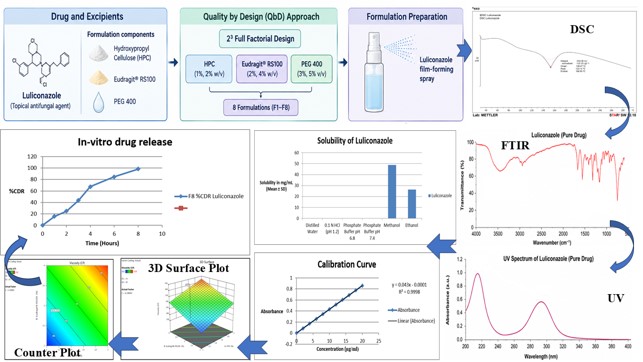
Luliconazole is a topical antifungal agent used in the management of superficial fungal infections. Film-forming topical sprays may provide convenient application and facilitate the formation of a uniform drug-containing film at the site of administration. The present study aimed to develop and optimize a Luliconazole film-forming spray using a Quality by Design (QbD) approach. A (2^3) full factorial design was employed to investigate the effects of Hydroxypropyl Cellulose (HPC), Eudragit® RS100, and PEG 400 on critical formulation responses, with drying time and viscosity selected as dependent variables. Eight formulations (F1–F8) were prepared by varying the concentrations of the selected formulation components and evaluated for appearance, film formation, pH, viscosity, drying time, spray angle, film thickness, folding endurance, stickiness, washability, leak test, drug content, and in vitro drug diffusion. Statistical analysis and response-surface methodology were used for formulation optimization. The prepared formulations were clear and homogeneous and exhibited acceptable film-forming properties. Drying time ranged from 3.8 to 8.2 min, while viscosity ranged from 162 to 438 cP. The formulation variables significantly influenced the investigated responses. Formulation F8, containing 1% w/v HPC, 4% w/v Eudragit® RS100, and 5% v/v PEG 400, was selected as the optimized formulation. F8 exhibited a drying time of 5.1 min, viscosity of 304 cP, and spray angle of 83.6°. It produced a uniform, transparent, non-sticky, and adherent film, with drug content of 99.2 ± 0.8%. The QbD approach enabled systematic optimization of the Luliconazole film-forming spray and identified F8 as a promising formulation with desirable spray and film-forming characteristics for topical drug delivery.Downloads
References
1. Shi G, Guo Y, Yang M. Development and optimization of a novel nanocarrier SabiWhite-loaded ethosomal gel for targeted skin inflammation complicated by multidrug-resistant pathogens. Front Cell Infect Microbiol. 2025;15. doi: 10.3389/fcimb.2025.1640799.
2. Zhu Z, Li W, Yin Y, Cao R, Li Z. Differential Scanning Calorimetry Material Studies: Benzil Melting Point Method for Eliminating the Thermal History of DSC. Vol. 2022, Journal of Chemistry. 2022. doi: 10.1155/2022/3423429.
3. Shaligram PS, George CP, Sharma H, Mahadik KR, Patil S, Vanka K, et al. Rivaroxaban eutectics with improved solubility, dissolution rates, bioavailability and stability. CrystEngComm. 2023;25(22):3253–63. doi: 10.1039/d3ce00261f.
4. Liaqat R, Rasool F, Noreen S, Rai N, Naseem A, Shoaib MH, et al. Fabrication, characterization, and docking studies of furosemide-loaded nanosponges using the emulsion solvent diffusion method. Nanomedicine. 2025;20(11):1235–47. doi: 10.1080/17435889.2025.2501518.
5. Chaudhari Rn, L.Khan S, Chaudhary Rs, Jain Sp, Sidduqui Fa. Β-Sitosterol: Isolation From Muntingia Calabura Linn Bark Extract, Structural Elucidation And Molecular Docking Studies As Potential Inhibitor Of SARS-CoV-2 Mpro (COVID-19). Asian J Pharm Clin Res. 2020;204–9. doi: 10.22159/ajpcr.2020.v13i5.37909.
6. Alhabardi SA, Almutairi JA, Al-Hamoud GA, Zakaraya ZZ, Hani U, Asiri ZAA, et al. Musa Paradisiaca derived intrinsically heteroatom doped carbon dots as antioxidant and controlled drug release behavior. PLoS One. 2025;1–19. doi: 10.1371/journal.pone.0329116.
7. Pham DT, Nguyen DXT, Nguyen NY, Nguyen TTL, Nguyen TQC, Tu AVT, et al. Development of pH-responsive Eudragit S100-functionalized silk fibroin nanoparticles as a prospective drug delivery system. PLoS One. 2024;19(5 May). doi: 10.1371/journal.pone.0303177.
8. Patil VP, Khulb P. Isolation and Identification of Bioactive Chlorogenic Acid from Ethanol Fraction of Cordia subcordata: HPLC, HPTLC, FTIR, and LC-MS Analysis. Int J Pharm Qual Assur. 2024;15(03):1144–50. doi: 10.25258/ijpqa.15.3.07.
9. Vanitha A, Kalimuthu K, Chinnadurai V, Nisha KMJ. Phytochemical screening, FTIR and GCMS analysis of aqueous extract of Caralluma bicolor – An endangered plant. Asian J Pharm Pharmacol. 2019;5(6):1122–30. doi: 10.31024/ajpp.2019.5.6.7.
10. Huang Y, Liu Y, Tan H, Cheng Y, Tao K, Gu D, et al. Assessing essential oil composition in Cinnamomum cassia leaves from different regions of China using GC-MS and FTIR spectroscopy. Czech J Food Sci. 2024;42(3):141–52. doi: 10.17221/197/2023-CJFS.
11. Dezani AB, Pereira TM, Caffaro AM, Reis JM, Serra CH dos R. Equilibrium solubility versus intrinsic dissolution: Characterization of lamivudine, stavudine and zidovudine for BCS classification. Brazilian J Pharm Sci. 2013;49(4):853–63. doi: 10.1590/S1984-82502013000400026.
12. Romdhani A, Martínez F, Chiappetta DA, Peña Á, Jouyban A. Equilibrium Solubility of Acetaminophen in Ternary Mixtures as a Tool for Design of Concentrated Parenteral Medications. J Solution Chem. 2024;53(3):506–23. doi: 10.1007/s10953-023-01347-3.
13. Ramadoss K, Meerasa SS, Satyapal AKS, Vijayakumar A, Venugopal V. Quantitative analysis of favipiravir in bulk and pharmaceutical dosage forms using UV visible spectrophotometer. J Med Pharm Allied Sci. 2023;12(2):5680–3. doi: 10.55522/jmpas.v12i2.4410.
14. Tayeng D, Das S, Das S, Chetia D. UV Spectrophotometric Method Development And Validation For The Combined Plant Extract Traditionally Used In Arunachal Pradesh To Treat Malaria. J Neonatal Surg. 2025;14(30S):975–83. doi: 10.63682/jns.v14i30S.7533.
15. Sawant MP, Deokar GS. Solubility Profiling and UV-Spectrophotometric Determination of Bioactive Peptides from Ragi. Int J Drug Deliv Technol. 2025;15(3):1265–71. doi: 10.25258/ijddt.15.3.47.
16. N V, SK AP, Yadala PC, M S. UV spectrophotometric method for the estimation of pure nicotine. J Innov Appl Pharm Sci. 2025;37–45. doi: 10.37022/jiaps.v10i3.766.
17. Fernández-Pérez A, Marbán G. Visible Light Spectroscopic Analysis of Methylene Blue in Water. J Appl Spectrosc. 2022;88(6):1284–90. doi: 10.1021/acsomega.0c03830.
18. Azadeh M, Gorovits B, Kamerud J, MacMannis S, Safavi A, Sailstad J, et al. Calibration Curves in Quantitative Ligand Binding Assays: Recommendations and Best Practices for Preparation, Design, and Editing of Calibration Curves. AAPS J. 2018;20(1). doi: 10.1208/s12248-017-0159-4.
19. Kumatia EK, Ofosu-Koranteng F, Appiah AA, Barimah KB. Standardization and Quality Control of the Herbal Medicine Mist Nibima, Employed to Treat Malaria and COVID-19, Using Physicochemical and Organoleptic Parameters and Quantification of Chemical Markers via UHPLC-MS/MS. Int J Anal Chem. 2021;2021. doi: 10.1155/2021/6390481.
20. Adebowale ARA, Sanni LO. Effects of solid content and temperature on viscosity of tapioca meal. J Food Sci Technol. 2013;50(3):573–8. doi: 10.1007/s13197-011-0363-7.
21. Ajith K, Pillai AS, Muthu Vijayan Enoch I V., Sharifpur M, Solomon AB, Meyer JP. Effect of the non-electrically conductive spindle on the viscosity measurements of nanofluids subjected to the magnetic field. Colloids Surfaces A Physicochem Eng Asp. 2021;628. doi: 10.1016/j.colsurfa.2021.127252.
22. Zhu W, Long J, Shi M. Release Kinetics Model Fitting of Drugs with Different Structures from Viscose Fabric. Materials (Basel). 2023;16(8). doi: 10.3390/ma16083282.
23. Askarizadeh M, Esfandiari N, Honarvar B, Sajadian SA, Azdarpour A. Kinetic Modeling to Explain the Release of Medicine from Drug Delivery Systems. ChemBioEng Rev. 2023;10(6):1006–49. doi: 10.1002/cben.202300027.
24. Baishya H. Application of Mathematical Models in Drug Release Kinetics of Carbidopa and Levodopa ER Tablets. J Dev Drugs. 2017;06(02). doi: 10.4172/2329-6631.1000171.
25. Tembhare E, Gupta KR, Umekar MJ. An Approach to Drug Stability Studies and Shelf-life Determination. Arch Curr Res Int. 2019;1–20. doi: 10.9734/acri/2019/v19i130147.
26. McKinney E, Deshpande A, Verrilli B, Li C, Sorel D, Kim E, et al. Evaluation of Room Temperature and Accelerated Stability Data For Fitusiran, an Investigational Rnai Therapeutic Targeting Antithrombin for Treatment of Hemophilia and Rare Bleeding Disorders. Haemophilia. 2017;23(S2):59[P051].
Downloads
Published
Issue
Section
License
Copyright (c) 2026 Avanti S. Ghadage, Madan D. Pomaje, Ashwini B. Patil (Author)

This work is licensed under a Creative Commons Attribution-NonCommercial 4.0 International License.
In submitting an article to the Journal of PharmTechNova (JPTN) I certify that:
- I am authorized by my co-authors to enter into these arrangements.
- I warrant, on behalf of myself and my co-authors, that:
- the article is original, has not been formally published in any other peer-reviewed journal, is not under consideration by any other journal and does not infringe any existing copyright or any other third party rights;
- I am/we are the sole author(s) of the article and have full authority to enter into this agreement and in granting rights to JPTN are not in breach of any other obligation;
- the article contains nothing that is unlawful, libellous, or which would, if published, constitute a breach of contract or of confidence or of commitment given to secrecy;
- I/we have taken due care to ensure the integrity of the article. To my/our - and currently accepted scientific - knowledge all statements contained in it purporting to be facts are true and any formula or instruction contained in the article will not, if followed accurately, cause any injury, illness or damage to the user.
- I, and all co-authors, agree that the article, if editorially accepted for publication, shall be licensed under the Creative Commons Attribution-NonCommercial 4.0 International License
- I, and all co-authors, agree that, if the article is editorially accepted for publication in the Journal of PharmTechNova (JPTN) data included in the article shall be made available under the Creative Commons 1.0 Public Domain Dedication waiver, unless otherwise stated. For the avoidance of doubt it is stated that sections 1, 2, and 3 of this license agreement shall apply and prevail.