In Vitro Antifungal Evaluation of a Posaconazole-Loaded Menthosomal Hydrogel Against Candida albicans
DOI:
https://doi.org/10.66220/sa9txf12Keywords:
Posaconazole, Menthosomes, Hydrogel, Antifungal activity, Candida albicans, Agar well diffusion, Zone of inhibition, In vitro evaluationAbstract
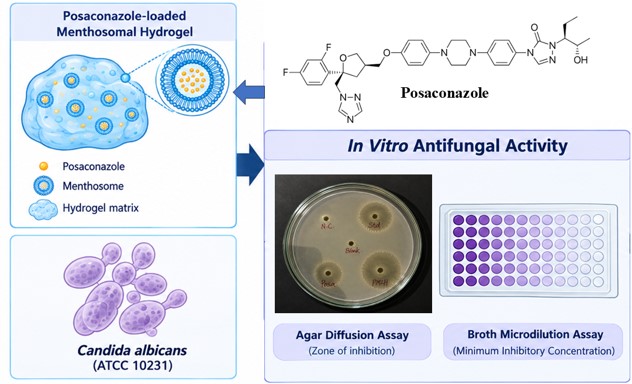
Posaconazole is a broad-spectrum triazole antifungal agent used against a range of pathogenic fungi. The present study aimed to evaluate the in vitro antifungal activity of an optimized Posaconazole-loaded Menthosomes hydrogel (PMLH) against Candida albicans. The antifungal activity was assessed using the agar well diffusion method, with the zone of inhibition (ZOI) used as the primary response. The optimized PMLH formulation was evaluated in comparison with a marketed Posaconazole formulation and Posaconazole active pharmaceutical ingredient (API). A drug-free hydrogel base and blank well were included as controls to determine the contribution of the formulation matrix and experimental setup to the observed antifungal activity. The optimized PMLH contained 90.20 ± 0.6% drug content and was tested at an equivalent Posaconazole concentration of 10 µg/mL. Following incubation, the ZOI was measured in millimetres. The PMLH exhibited a ZOI of 26.9 ± 1.7 mm, compared with 24.4 ± 1.5 mm for the marketed Posaconazole formulation and 18.8 ± 1.3 mm for Posaconazole API. No visible inhibition was observed for either the drug-free hydrogel base or blank. The larger inhibition zone produced by PMLH indicates enhanced apparent antifungal activity under the conditions of the agar diffusion assay and may be associated with improved drug dispersion and diffusion from the Menthosomal hydrogel matrix. However, the observed ZOI is also influenced by formulation viscosity, drug release, partitioning, and diffusion. Overall, the findings support the potential of PMLH as a promising formulation approach for improving the apparent antifungal performance of Posaconazole against C. albicans. Further standardized studies are warranted to confirm these findings.
Downloads
References
1. Sharma K, Parmanu PK, Sharma M. Mechanisms of antifungal resistance and developments in alternative strategies to combat Candida albicans infection. Arch. Microbiol., 206, (2024). doi: 10.1007/s00203-023-03824-1.
2. Mallick DC, Kaushik N, Goyal L, Mallick L, Singh P. A Comprehensive Review of Candidemia and Invasive Candidiasis in Adults: Focus on the Emerging Multidrug-Resistant Fungus Candida auris. Diseases, 13, (2025). doi: 10.3390/diseases13040093.
3. Shi H, Li M, Zhou Z, Lu A, Wang Z. Synthesis and Biological Evaluation of Novel 1,2,4-Triazole Derivatives Containing Amino Acid Fragments. Molecules, 30, (2025). doi: 10.3390/molecules30081692.
4. Vijaykumar V, Saikiran M, Bharathy VR, Ubaidulla U. Formulation Challenges in Dermal Drug Delivery Systems: A Comprehensive Review of Physicochemical Properties and Advanced Delivery Strategies. Int. J. Drug Deliv. Technol., 14, (2024). doi: 10.25258/ijddt.14.4.29.
5. Abd El Gawad MM, Shady RM. Advanced Strategic Nanocarriers Containing Posaconazole as an Antifungal Drug for the Treatment of Fungal infection, Targeting topical, Ocular, Vaginal, and Systemic Delivery. J. Pharm. Innov., 21, (2026). doi: 10.1007/s12247-026-10405-4.
6. Jacob S, Varkey NR, Nair AB. Ultradeformable Vesicles for Wound Healing: Ethosomes, Transferosomes, and Transethosomes in Topical Drug Delivery. Pharmaceutics, 18, (2026). doi: 10.3390/pharmaceutics18030361.
7. Petrovici AG, Spennato M, Bîtcan I, Péter F, Cotarcă L, Todea A, Ordodi VL. A Comprehensive Review of Azelaic Acid Pharmacological Properties, Clinical Applications, and Innovative Topical Formulations. Pharmaceuticals, 18, (2025). doi: 10.3390/ph18091273.
8. Opatha SAT, Titapiwatanakun V, Chutoprapat R. Transfersomes: A promising nanoencapsulation technique for transdermal drug delivery. Pharmaceutics, 12, 1–23 (2020). doi: 10.3390/pharmaceutics12090855.
9. Alberts A, Bratu AG, Niculescu AG, Grumezescu AM. New Perspectives of Hydrogels in Chronic Wound Management. Molecules, 30, (2025). doi: 10.3390/molecules30030686.
10. Lin X, Zhang X, Wang Y, Chen W, Zhu Z, Wang S. Hydrogels and hydrogel-based drug delivery systems for promoting refractory wound healing: Applications and prospects. Int. J. Biol. Macromol., 285, (2025). doi: 10.1016/j.ijbiomac.2024.138098.
11. Visan AI, Negut I. Development and Applications of PLGA Hydrogels for Sustained Delivery of Therapeutic Agents. Gels, 10, (2024). doi: 10.3390/gels10080497.
12. Lee JH, Kim YG, Park I, Lee J. Antifungal and antibiofilm activities of flavonoids against Candida albicans: Focus on 3,2′-dihydroxyflavone as a potential therapeutic agent. Biofilm, 8, (2024). doi: 10.1016/j.bioflm.2024.100218.
13. Freitas CG, Felipe MS. Candida albicans and Antifungal Peptides. Infect. Dis. Ther., 12, 2631–48 (2023). doi: 10.1007/s40121-023-00889-9.
14. Rajia S, Fujii Y, Kawsar SMA, Ozeki Y, Jahan S, Hasan I. Effectiveness of Microbiological Assays as an Alternative Method to Determine the Potency of Antibiotics: A Review. Hacettepe Univ. J. Fac. Pharm., 44, 153–64 (2024). doi: 10.52794/hujpharm.1354419.
15. Peiter GC, Salvador E da S, Ayma FC, Teixeira KN, Jaerger S, Bini RA, Busso C, Oliveira RJ de, Schneider R. A Metalless and Fungicide-Free Material Against Candida: Glass-Loaded Hydrogels. Pharmaceutics, 17, (2025). doi: 10.3390/pharmaceutics17070836.
16. Fernando A, Perera R, Jayawardane MAMM, Saavedra R. Antifungal effect of Aloe barbadensis Miller gel extract on Candida albicans: Development of an eco-friendly herbal antifungal finish on cotton fabric for medical application. Discov. Appl. Sci., 6, (2024). doi: 10.1007/s42452-024-05628-4.
17. Hardianti S. Media Alternatif Kacang Merah (Phaseolus vulgaris L) Sebagai Pengganti Media SDA (Sabouraud Dextrose Agar) Untuk Pertumbuhan Jamur Candida albicans. Deli Med. Heal. Sci. J., 1, 7–11 (2024). doi: 10.36656/jdmhc.v1i2.1789.
18. Rama A, Govindan I, Hebbar S, Chaturvedi A, Rani U, Naha A. Advancing posaconazole quantification analysis with a new reverse-phase HPLC method in its bulk and marketed dosage form. F1000Research, 12, (2023). doi: 10.12688/f1000research.132841.2.
19. Nithin KR, Pallavi GM, Srikruthi KS, Abass KS, Naveen NR. Ternary phase optimized indomethacin nanoemulsion hydrogel for sustained topical delivery and improved biological efficacy. Sci. Rep., 15, (2025)/ doi: 10.1038/s41598-025-27205-4.
20. Thirupathi K, Raorane CJ, Ramkumar V, Ulagesan S, Santhamoorthy M, Raj V, Krishnakumar GS, Phan TTV, Kim SC. Update on Chitosan-Based Hydrogels: Preparation, Characterization, and Its Antimicrobial and Antibiofilm Applications. Gels, 9, (2023). doi: 10.3390/gels9010035.
Downloads
Published
Issue
Section
License
Copyright (c) 2026 Namita Subhanrao Bhosale, Dinesh Kumar Upadhyayv, Vijay Arjun Jagtap (Author)

This work is licensed under a Creative Commons Attribution-NonCommercial 4.0 International License.
In submitting an article to the Journal of PharmTechNova (JPTN) I certify that:
- I am authorized by my co-authors to enter into these arrangements.
- I warrant, on behalf of myself and my co-authors, that:
- the article is original, has not been formally published in any other peer-reviewed journal, is not under consideration by any other journal and does not infringe any existing copyright or any other third party rights;
- I am/we are the sole author(s) of the article and have full authority to enter into this agreement and in granting rights to JPTN are not in breach of any other obligation;
- the article contains nothing that is unlawful, libellous, or which would, if published, constitute a breach of contract or of confidence or of commitment given to secrecy;
- I/we have taken due care to ensure the integrity of the article. To my/our - and currently accepted scientific - knowledge all statements contained in it purporting to be facts are true and any formula or instruction contained in the article will not, if followed accurately, cause any injury, illness or damage to the user.
- I, and all co-authors, agree that the article, if editorially accepted for publication, shall be licensed under the Creative Commons Attribution-NonCommercial 4.0 International License
- I, and all co-authors, agree that, if the article is editorially accepted for publication in the Journal of PharmTechNova (JPTN) data included in the article shall be made available under the Creative Commons 1.0 Public Domain Dedication waiver, unless otherwise stated. For the avoidance of doubt it is stated that sections 1, 2, and 3 of this license agreement shall apply and prevail.